
Choosing software


Accelerator software does two separate jobs. One is running the programme: taking applications, choosing a cohort, delivering sessions, booking mentors, tracking milestones and reporting to whoever funds you. The other is keeping founders, mentors, investors and partners connected after the programme ends. Few products do both equally well, so work out which job costs your team more, then shortlist tools built for that one.
This comparison is for programme managers and heads of accelerators, incubators, innovation hubs and startup ecosystem organisations in the UK and Ireland. We make Portava, one of the products below, so every fact about the others is linked to its source, and we say where they are stronger. For the questions to ask any supplier about data, payments and contracts, start with our buyer's guide to choosing membership software.
Accelerator software should cover two sets of work. Programme operations: an application form, scoring and shortlisting, cohort sessions, mentor time, milestone tracking and reports for funders. Community: a directory of founders, mentors, investors and partners, events, a place to post opportunities, and messaging that keeps working after the cohort has finished.
Most programmes need something from both lists, rarely in equal measure. A publicly funded pre-accelerator with two cohorts a year and a quarterly report to its funder lives mostly in the first list. An innovation hub with a few hundred member companies and a monthly founders' breakfast lives mostly in the second.
Take your last cohort and write down where the staff hours went. On the programme side, look at the application round (how scores from outside reviewers were gathered and combined), booking mentors, collecting monthly figures from founders and writing the funder report. Note what still runs on spreadsheets and chasing emails.
On the community side, ask four questions. Could you email every founder from your last three cohorts today, at an address that still works? Do alumni come back to events? Do mentors stay involved once their cohort ends? And where do funding calls, tenders and partner offers get shared: somewhere every member can find them, or a group chat that newer founders never joined?
Whichever side has the longer list of workarounds is where your software budget should go first. Then decide what your funder needs from founders after they leave, such as whether they are still trading, and who will ask for it. That answer often decides whether you need one tool or two.
Specialist startup platforms such as AcceleratorApp and F6S concentrate on applications and deal flow. Learning platforms such as Disco concentrate on delivering the cohort. Community platforms such as Hivebrite and Circle, and membership platforms such as Portava, concentrate on the network that lasts. None fits every programme, so match the tool to the half that costs you most.
Each description below comes from the supplier's own website or help centre, linked in the text. Checked on 29 September 2026. Features we do not mention may still exist.
AcceleratorApp is built around the programme itself. Its application processing page describes a form builder that accepts answers including audio and video recordings, scoring sheets with your own evaluation criteria, judges assigned to each startup, and a round-by-round selection funnel. Its coaching tools page covers booking time from mentors' calendars and searchable meeting notes. Its startup data page describes monthly data forms tailored to each startup's business model and stage. The home page says its reports and dashboards are there to demonstrate value "to stakeholders and funders", and also covers courses and events. On application scoring and funder reporting, it is stronger than the community platforms here.
F6S is a place founders go to find programmes. Its accelerators listing shows programmes with application deadlines, locations and focus areas, and its help centre says any startup co-founder can apply to an open call on F6S. For the programme team, F6S Pipeline is a CRM that startup programmes, investors, corporates and governments use to gather leads from email, the web, application forms and spreadsheets, and to track and analyse deal flow together. Its strength is reaching founders who are already looking for a programme.
Disco is a learning platform. Its home page describes cohort-based or self-paced programmes, live events and chat inside each programme, reporting on progress, AI features and a mobile app for learning. Its page for training businesses names accelerators and incubators, and mentions leaderboards, feeds, groups and certificates. If your programme is mainly a curriculum, Disco is built for that. The pages we checked do not describe application scoring or an alumni network.
Hivebrite is a community platform. Its features page lists a member directory, groups for chapters and sub-communities, in-person and virtual events with RSVPs and check-in, forums, jobs and opportunities, memberships with tiers and renewals, and a native mobile app. Its mentoring page describes mentees applying to mentors directly or administrators making matches, with tracking of mentor participation and relationships. Its home page mentions engagement scoring and lifelong alumni communities. On mentoring, Hivebrite has more built in than Portava.
Circle's home page describes community spaces with discussions, messaging, courses, events and live streams, a member directory and analytics. It also covers paid memberships with branded checkout, AI agents and workflows, email broadcasts and automations, and a branded app for iOS and Android with push notifications. The home page does not mention accelerators or applications. It suits a founder community that mixes courses, live sessions and conversation, especially one that charges for access.
| What you need | AcceleratorApp | F6S | Disco | Hivebrite | Circle | Portava |
|---|---|---|---|---|---|---|
| Applications and scoring | Form builder, scoring sheets, judges | Open calls, deal flow CRM | Not described | Not described | Not described | Join applications approved by the team |
| Cohort delivery | Courses | Not described | Cohort and self-paced programmes | Groups for sub-communities | Courses, live streams | Programme and cohort management |
| Mentors | Calendars, meeting notes | Not described | Not described | Matching and tracking | Not described | In the directory, direct messages |
| Founder data and reports | Monthly data forms, funder reports | Deal flow analysis | Progress reporting | Analytics, engagement scoring | Analytics | Dashboard, engagement scores |
| Directory and messaging | Community member accounts | Founder and startup pages | Feeds, groups, chat | Directory, messaging | Directory, messaging | Directory, discussions, messages |
| Events | Registration, reminders, attendance | Startup event pages | Live events | RSVPs, check-in | Events, live streams | Tickets, QR check-in |
| Opportunities | Not described | Programme listings | Not described | Jobs and opportunities | Not described | Opportunities |
| Mobile app | Not described | Not described | Mobile app | Native app | Branded iOS and Android app | Branded mobile app |
"Not described" means the pages we checked did not mention it. The AcceleratorApp and F6S rows also draw on the AcceleratorApp documentation and the F6S help centre.
If panels of outside judges score your applications over several rounds, keep a tool built for that, such as AcceleratorApp. A community platform will send you back to a spreadsheet for the scoring. The same goes for a funder who expects monthly figures from every startup: moving mid-programme breaks the series of figures.
If most of your applicants find you through F6S, keep your open call there, whatever you use for the community afterwards. If mentoring is the heart of the programme, Hivebrite's matching and tracking do more than a directory and direct messages can. If the programme is mostly curriculum, Disco and Circle both run courses.
If your alumni already gather in a Hivebrite or Circle community that people use, moving them costs months of attention. Switch only when you can write down what you would gain.
Running two tools is a reasonable answer: one for the application round and the cohort, and one for everyone afterwards. It works when one named person moves each cohort across in the week it finishes, before founders scatter.
We make Portava, and for accelerators it sits on the community side of this comparison, with programme and cohort management and opportunities alongside. Members use a branded portal in any browser, and a branded mobile app is also available. Founders, mentors, investors and partners appear in a directory of people and organisations, and can message each other and join discussions. The team publishes events with QR-code tickets for check-in, posts news and resources, and sends surveys and email campaigns to chosen audiences. A mentor or a partner's contact can be invited as a guest with an end date. The team has a dashboard of membership, event and content analytics, plus engagement scores, and members can ask an AI assistant that answers from what the organisation has published.
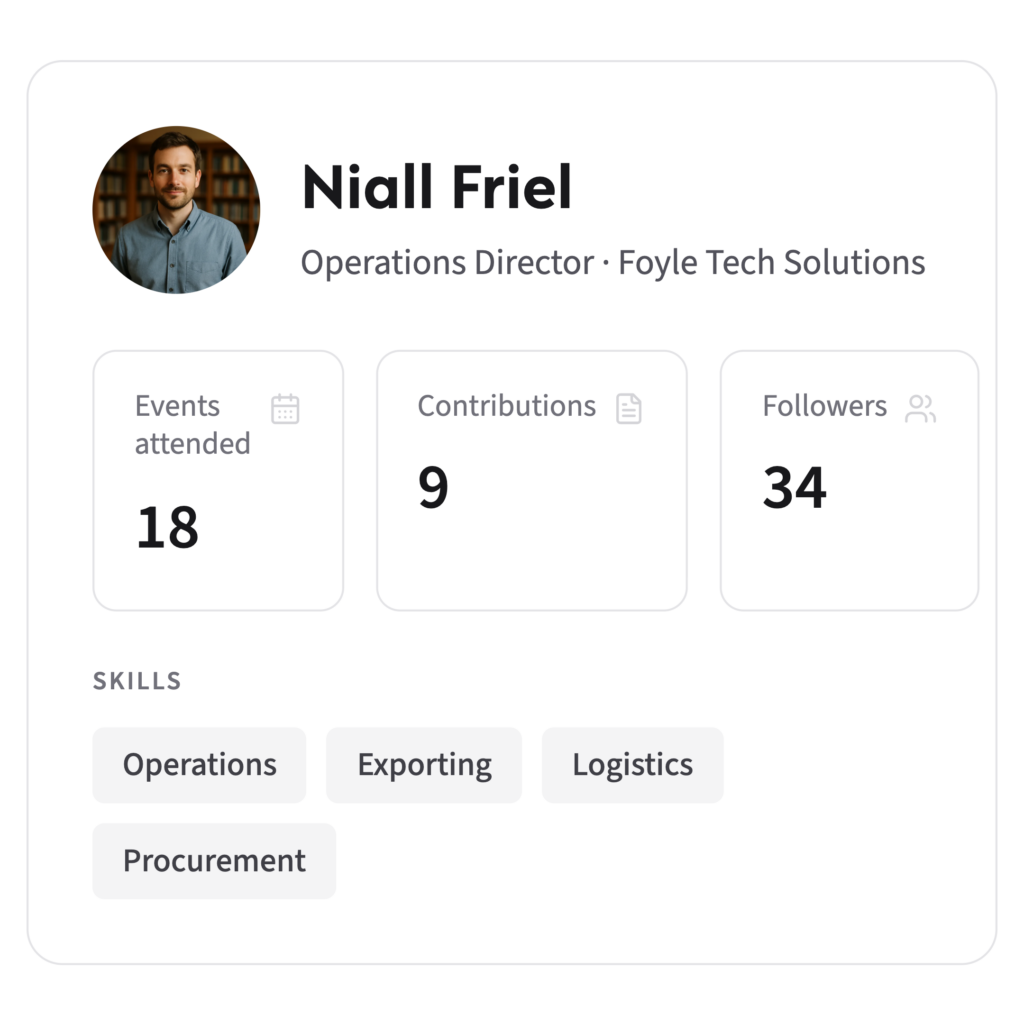
Example screen with sample data
Reporting is what you see on the dashboard. Exports are limited to subscriptions, invoices and contacts as CSV, and report exports in the shape a board asks for are on the roadmap, so plan to assemble a funder report yourself for now. If scored application rounds or mentor matching are central to your programme, ask us what Portava covers and compare it with AcceleratorApp and Hivebrite. See our startup ecosystems page, or request a demo with your own cohort in mind.
Hivebrite and Circle describe themselves as community platforms, Disco pairs learning with community tools, and membership platforms such as Portava combine a community with events and billing. None suits every organisation. Choose by the job that matters most: courses point towards Disco or Circle, mentoring towards Hivebrite, and paid membership with regular events towards a membership platform.
Sometimes, depending on how demanding each end is. If your application round is a short form reviewed by two staff members, a community platform may cover it. If panels score applications over several rounds, or your funder needs monthly founder data, use a specialist tool for the programme and a community platform for everyone afterwards.
Move the cohort into the alumni community in the week it finishes, while contact details still work. Then give alumni reasons to return: opportunities with closing dates, an event where they meet the new cohort, and introductions to mentors. Ask once a year, by survey, for the figures your funder needs from them.
Yes, if founders should find them after the programme. A mentor known only to one manager leaves when that manager does. Give mentors, investors and partners a profile in the same directory as founders, with time-limited access for anyone involved in one cohort.
AcceleratorApp, F6S, Disco, Hivebrite and Circle are trademarks of their respective owners.